Viaknox is open for business
Six products, two services and one front door. What Viaknox is, what you can use today, what we do alongside you, and how to reach a person quickly.
Tune-Up is a free, open-source bot that gives your AI agents a regular check-up. It reviews them against clear standards, turns every miss into a test, and suggests small fixes you approve first. It also comes with a skill index that keeps agent instructions short. In our own test, it cut the instructions an agent carries on every message by 77%, compared with pasting Tune-Up’s seven skills straight into the prompt.
It works with Grok Bot today. Version 0.3.4 is out now under the MIT license at agenttuneup.ai.
Because they drift, and nobody notices. The same four problems show up again and again:
Most people set an agent up once and never look at it again. Nothing tells you when it starts slipping.
Tune-Up is itself a bot. You set it up once and it looks after your other agents.
Setup asks four questions: which agents to look after, what must never change, whether to only suggest or to apply after your yes, and how often to check.
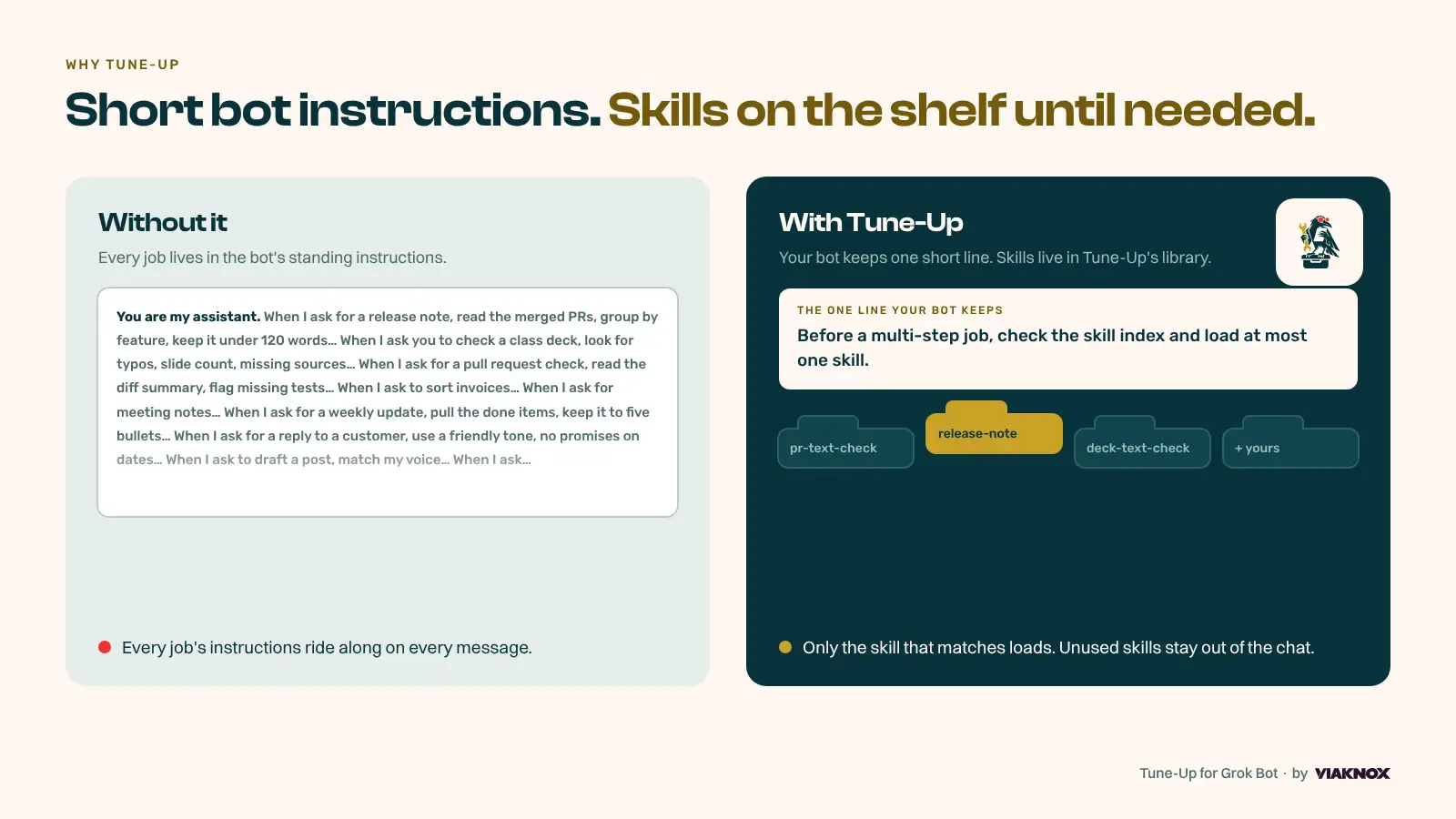
Most agents carry every job they know in their standing instructions. “When I ask for a release note, do this. When I ask for a deck check, do that.” All of it rides along with every message, whether you need it or not.
A skill is a saved way to do one job, kept in its own file (Grok Bot’s docs call it “a reusable set of instructions for how to do a task”). With Tune-Up’s skill index, the agent keeps one short rule plus a one-line label for each skill. The full skill loads only on the turn that needs it, and at most one at a time.
We measured both ways on the skills that ship in the Tune-Up repo at v0.3.4 (commit 07e6330). “Pasted in” is the full text of every SKILL.md. “With the skill index” is the always-on rule plus one name: description label per skill; the worst case adds the largest skill on the turn it loads.
| Skills | Every job pasted in | With the skill index | On the turn a skill loads (worst case) |
|---|---|---|---|
| Tune-Up’s 4 core skills | 2,963 | 648 | 1,589 |
| All 7 skills in the repo | 3,108 | 701 | 1,642 |
| Just the 3 starter skills | 145 | 318 | 371 |
Tokens of instructions per message. Counted with OpenAI’s o200k tokenizer as a stand-in, because we couldn’t find a published tokenizer for Grok Bot. Read the numbers as relative, not exact. These are our own skills, not a sample of everyone’s.
Two honest findings:
Our rule of thumb: if a job fits in two lines, leave it in the instructions. If it’s a procedure, give it a skill.
It takes about a minute:
Then say “set up Tune-Up” to meet the bot. If something breaks or feels like noise, tell us on GitHub.
No. It shows every change first and applies one only after you say yes. It never changes an agent's purpose, and never deletes or renames one without your yes.
Grok Bot today. We want it to work with other agents too, but we don't promise dates.
No. It pays off when your jobs are longer than a couple of lines. With three two-line skills it cost more than pasting them in, because the always-on rule alone is about 265 tokens.
Nothing. The code and text are free under the MIT license. The Tune-Up name, raven mascot and brand art are not covered by MIT.
story-gate checks the code an AI agent writes, one story at a time. Tune-Up checks the agents themselves, and how they behave over time.
 Free tool · private beta
Ask your bot to check your chat. Agent Tune-Up grades it on 5 simple checks and tells you the one fix to make first. It works inside Grok Bot, Claude, ChatGPT and Cursor. Nothing to install.
Type your email in the box at the bottom. We email you a link. Open it, and your connector page has everything you need for step 2.
Your connector page gives you one message to copy. Paste it into your bot, then paste your private token into the hidden field it shows (never into the chat). Your bot adds Tune-Up itself.
Grok Bot: exactly as above. No settings to find.
Claude Code or Cursor: your connector page has a ready-made line to copy.
Claude.ai or ChatGPT: skip the email. Add a custom connector with the address https://viaknox.com/api/tuneup/mcp and sign in with your email when it asks.
Codex (app, CLI or IDE on your computer): skip the email. Run codex mcp add agent-tune-up --url https://viaknox.com/api/tuneup/mcp and sign in when your browser opens.
Open your chat with the bot, the way you always do. In Grok Bot, type @ and pick Agent Tune-Up first. Then say:
check our chat so far
Your bot sends Tune-Up the conversation and its own instructions. Nothing to copy or paste.
Chat from another app? Paste it in instead. Your connector page has a fill-in message for that.
In about a minute your bot shows the report card. Each check gets a ✅ or ❌ with the reason, in plain words.
It ends with "What to change" (up to three things, worst first) and the lines to paste, with where to paste them for your app. Paste, save, and check your next chat to see if it worked.
Tune-Up is a bot that checks your AI agents, turns every miss into a test and suggests small fixes you approve, with a skill index that loads one skill only when it's needed.

Tune-Up is a bot that checks your AI agents, turns every miss into a test and suggests small fixes you approve, with a skill index that loads one skill only when it's needed.